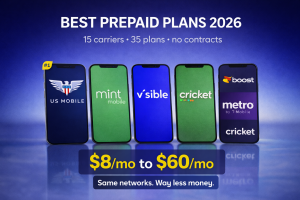
The best prepaid phone plans no contract currently available in the US start as low as $0 to $25 per month, offer unlimited talk and text, and run on the same major networks (Verizon, AT&T, T-Mobile) as postpaid carriers. According to the Federal Communications Commission, prepaid wireless now accounts for roughly one in four mobile subscriptions nationwide, reflecting a steady consumer shift away from long-term contracts toward flexible, pay-as-you-go models. This guide compares the top no contract cell phone plans USA shoppers are choosing today, breaks down what you actually get for your money, and explains how to pick the right plan based on data needs, network coverage, and budget.
What “No Contract” Really Means in 2026
A no-contract prepaid plan means you pay for service in advance—typically month to month—without signing a multi-year agreement, undergoing a credit check, or paying early termination fees. The Consumer Financial Protection Bureau notes that traditional postpaid contracts can carry termination penalties of $175 to $350, while prepaid plans let you cancel or switch carriers at any time without financial penalty.
Modern prepaid service is functionally similar to postpaid: you get 5G access, unlimited talk and text, and in many cases mobile hotspot data and international calling. The key differences are that taxes and fees are often included in the advertised price, autopay is optional rather than required, and most carriers allow you to bring your own phone (BYOD) by inserting a SIM or activating an eSIM. For households trying to control monthly bills, pay as you go phone plans USA carriers offer represent one of the few areas of the telecom market where pricing has actually decreased over the past five years, according to Bureau of Labor Statistics Consumer Price Index data on wireless telephone services.
How Prepaid Plans Compare to Postpaid
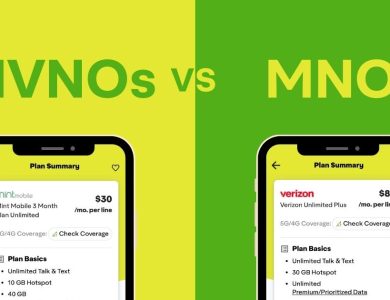
The most recent industry analysis from CNET indicates that average prepaid customers save between $300 and $600 annually compared to equivalent postpaid plans on the same network [4]. That’s because prepaid carriers operate with lower overhead—no credit underwriting, no device financing on most plans, and fewer retail touchpoints.
However, there are tradeoffs worth understanding:
- Data prioritization: Prepaid users may experience slower speeds during network congestion compared to premium postpaid customers.
- Device financing: Most prepaid carriers require you to pay full price for a phone or bring your own, though some now offer installment plans.
- Perks: Streaming bundles (Netflix, Apple TV+, Disney+) are typically reserved for postpaid lines.
- International roaming: Coverage abroad is more limited on prepaid, though carriers like Lyca Mobile specialize in international calling to 100+ countries [1].
For most US adults who already own an unlocked phone and primarily use Wi-Fi at home and work, prepaid delivers nearly identical service at a fraction of the cost.
The Cheapest Monthly Prepaid Phone Plans
If your goal is the lowest possible bill, several carriers compete aggressively at the entry level. TextNow offers a $0 Free Flex Plan—the cheapest option on the market—with no contract or credit check, supported by ads and Wi-Fi calling [9]. It’s ideal for light users who spend most of their day on Wi-Fi.
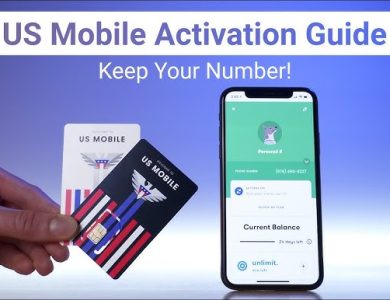
Among paid options, Connect by T-Mobile starts at $15 per month with no contracts or credit checks [2], making it one of the cheapest plans on a major US network. US Mobile’s Light Plan is frequently cited as the most affordable option for Wi-Fi-heavy users and operates on Verizon, AT&T, or T-Mobile networks at your choice [4]. For unlimited data at a low price, US Mobile’s Unlimited Starter at $22.50 per month includes unlimited data, 20GB hotspot, 5G, taxes, and free international calling [8].
When ranking the monthly prepaid phone plans cheapest shoppers should consider, the sweet spot for most users falls between $15 and $30 per month—enough to secure unlimited talk, text, and a usable data allotment without overpaying for features you won’t use.
Best Unlimited Data Prepaid Plans
For heavy data users, unlimited prepaid plans have become remarkably competitive. Visible, owned by Verizon, is recommended by industry reviewers as one of the best prepaid plans on the market at $25 per month with unlimited data on Verizon’s network [5]. Straight Talk offers plans starting at $25 per month with unlimited 5G data on multiple major networks [3].
Verizon Prepaid directly offers unlimited plans with $100 in service credits distributed over 10 months and no annual contracts [7], effectively lowering the per-month cost for customers willing to stay enrolled. AT&T Prepaid includes its Level Up benefit in all single-line monthly plans, which automatically rewards loyalty with bonus data or discounts [6].
Here’s a quick comparison of leading unlimited prepaid options:
| Carrier | Starting Price | Network | Key Feature |
|---|---|---|---|
| Visible | $25/mo | Verizon | Taxes and fees included [5] |
| US Mobile Unlimited Starter | $22.50/mo | VZ/ATT/TMO | 20GB hotspot, international calling [8] |
| Straight Talk | $25/mo | Multi-network | Unlimited 5G [3] |
| Verizon Prepaid | Varies | Verizon | $100 in service credits [7] |
| AT&T Prepaid | Varies | AT&T | Level Up rewards [6] |
Best Prepaid Plans for International Calling
For US residents who regularly call family abroad, certain prepaid carriers specialize in international service. Lyca Mobile offers low monthly prices combined with unlimited talk and text, high-speed 5G data, and international calling to more than 100 countries—a feature bundled into the base plan rather than sold as an add-on [1]. According to US Census Bureau data, roughly 14% of US residents are foreign-born, and demand for international-friendly mobile service has grown steadily.
US Mobile’s Unlimited Starter also includes free international calling at $22.50 per month [8], making it a strong all-around choice for bilingual households. When evaluating international features, check three things: which destination countries are included, whether calls to mobile numbers (not just landlines) are covered, and whether the included minutes are truly unlimited or capped. Some carriers advertise “international calling” but limit it to landlines in a handful of countries, so reading the fine print is essential before switching.
Best Prepaid Plans for Low-Income Households
Tracfone provides no-contract 5G prepaid plans with no hidden fees and is one of the carriers that participates in the federal Lifeline program, which offers subsidized phone service for qualifying low-income customers [10]. According to the Universal Service Administrative Company, Lifeline provides up to $9.25 per month toward phone or internet service for eligible households—those at or below 135% of federal poverty guidelines, or participating in programs like SNAP, Medicaid, or SSI.
To qualify, applicants must verify eligibility through the National Verifier at LifelineSupport.org. The benefit is limited to one per household and is non-transferable. Beyond Tracfone, several smaller mobile virtual network operators (MVNOs) participate in Lifeline, though availability varies by state. Connect by T-Mobile’s $15 per month entry-level plan [2] and TextNow’s $0 Free Flex Plan [9] are also worth considering for budget-constrained households even without Lifeline enrollment. The combination of federal assistance and aggressive prepaid pricing has made basic mobile service more accessible than at any prior point in the US wireless market.
What Experts Recommend
Industry analysts and consumer technology reviewers generally agree on a tiered approach to choosing a prepaid plan. For light users—those primarily on Wi-Fi who use mobile data only occasionally—experts recommend starting with a sub-$15 plan or even a free tier like TextNow’s Flex Plan [9]. The risk of overpaying for unused data is greater than the risk of running short, since most plans allow easy upgrades mid-cycle.
For average users consuming 5 to 15 GB of data per month, reviewers consistently point to mid-tier options like Visible at $25 [5], Straight Talk at $25 [3], or US Mobile’s Unlimited Starter at $22.50 [8]. These plans deliver postpaid-equivalent service at significant savings.
For heavy users and frequent travelers, experts recommend the premium prepaid tiers from Verizon Prepaid [7] or AT&T Prepaid [6], which include perks like Level Up rewards and service credits that approximate the postpaid experience. The consistent expert advice is to audit your actual data usage—visible in your phone’s settings—before choosing a plan, rather than defaulting to unlimited “just in case.”
How to Switch to a Prepaid Plan
Switching is straightforward and federally protected. Under FCC rules, your phone number is yours to keep, and carriers must allow porting without charge. Here’s the typical process:
- Check phone compatibility. Most unlocked phones work on any US network, but confirm your device supports the bands used by your chosen carrier’s network.
- Order a SIM or eSIM. Many carriers ship free SIMs; eSIMs activate instantly online.
- Gather port-in information. You’ll need your current account number, PIN, and billing zip code.
- Activate the new plan. Do not cancel your old service first—porting automatically closes the old account.
- Test thoroughly. Confirm calling, texting, data, and visual voicemail all work before relying on the new line.
The entire process usually takes 15 minutes to a few hours. If you encounter issues, the FCC accepts complaints about porting delays at fcc.gov/complaints.
When to Consult a Professional
While most consumers can choose and activate a prepaid plan independently, certain situations warrant additional guidance. If you rely on your phone for medical alert services, work-issued security tools, or business communications, consult your employer’s IT department or device manufacturer before switching carriers to confirm compatibility. Households enrolling in Lifeline should work directly with USAC-approved providers to avoid scams; the FTC has documented cases of fraudulent third parties charging fees for what is a free federal program. Finally, if you’re locked into a current postpaid contract, review your termination terms before porting out—some carriers will bill remaining device installments immediately upon cancellation.
References
- Best Prepaid Phone Plans: No Contract SIM Only Plans – Lyca Mobile
- Affordable Phone Plans Starting at $15/Mo. | Connect by T-Mobile
- Straight Talk Wireless | No Contract Phones and Plans
- Best Prepaid Phone Plans – CNET
- Best Cheap Prepaid Phone Plans – WhistleOut
- Affordable AT&T Prepaid Phone Plans & Devices – No Contract
- Best Prepaid Plans, Phones & Mobile Hotspots | Verizon Prepaid
- Best Prepaid Phone Plans | 15 Carriers Ranked – US Mobile
- Cheapest Prepaid Phone Plans – TextNow
- No Contract 5G Prepaid Plans & Smartphones – Tracfone
Frequently Asked Questions
- What is the cheapest no contract cell phone plan in the USA?
- TextNow’s $0 Free Flex Plan is the cheapest no contract cell phone plan in the USA, offering basic service with no monthly fee, no contract, and no credit check. It’s supported by ads and works best for users who rely heavily on Wi-Fi calling. Among paid options, Connect by T-Mobile starts at $15 per month with no contracts or credit checks, and US Mobile’s Light Plan offers similarly low pricing for Wi-Fi-focused users. For unlimited data, US Mobile’s Unlimited Starter at $22.50 per month is among the most affordable options available.
- Can I keep my phone number when switching to a prepaid plan?
- Yes. Under FCC rules, all US wireless carriers must allow free number porting between providers, including from postpaid to prepaid. To transfer your number, you’ll need your current account number, PIN, and billing zip code. Do not cancel your existing service before initiating the port—the porting process automatically closes your previous account once the new line activates. Most ports complete within 15 minutes to a few hours, though it can occasionally take up to 24 hours. If delays exceed that, you can file a complaint with the FCC at fcc.gov/complaints.
- Do prepaid phone plans include 5G?
- Most major prepaid plans now include 5G access at no extra cost. Verizon Prepaid, AT&T Prepaid, Straight Talk, US Mobile, Visible, Lyca Mobile, and Tracfone all offer 5G connectivity on plans starting around $15 to $25 per month. Coverage depends on the underlying network your prepaid carrier uses—Verizon, AT&T, or T-Mobile—and your physical location. Older 4G LTE phones still work fine but won’t access 5G speeds. If 5G matters to you, confirm your device is 5G-capable and that your chosen carrier’s 5G network covers your home and work areas.
- Are prepaid phone plans worth it compared to postpaid?
- For most US adults, yes. Prepaid plans typically save customers $300 to $600 per year compared to equivalent postpaid plans on the same network, according to recent industry analysis. You get the same 5G coverage, unlimited talk and text, and often similar data allowances. The main tradeoffs are slower data speeds during network congestion, fewer streaming perks like bundled Netflix or Disney+, and the need to buy your phone outright or bring your own. If you already own an unlocked phone and don’t need premium perks, prepaid is almost always the better financial choice.
- Do I need a credit check for prepaid phone plans?
- No. One of the defining features of no contract cell phone plans USA carriers offer is that they do not require credit checks. Because you pay in advance each month, carriers don’t need to underwrite your creditworthiness. This makes prepaid plans accessible to consumers with limited or poor credit history, recent immigrants without US credit files, and young adults building credit. Connect by T-Mobile, Tracfone, US Mobile, Visible, and most other prepaid carriers explicitly advertise no credit check activation. You’ll typically only need a valid ID and a payment method to sign up.
- Can low-income households get free or discounted prepaid service?
- Yes. The federal Lifeline program provides up to $9.25 per month toward phone or internet service for qualifying low-income households. To qualify, your income must be at or below 135% of federal poverty guidelines, or you must participate in programs like SNAP, Medicaid, SSI, or federal public housing assistance. Tracfone and several other prepaid carriers participate in Lifeline. Apply through the National Verifier at LifelineSupport.org—the benefit is limited to one per household. Avoid third parties charging fees to enroll you, as Lifeline applications are always free directly through USAC.
- Which prepaid carrier has the best network coverage?
- Network coverage depends on which underlying carrier your prepaid plan uses. Verizon-based prepaid plans (Visible, Verizon Prepaid, Straight Talk on Verizon, US Mobile’s Warp network) generally have the broadest rural coverage in the US. AT&T-based plans (AT&T Prepaid, Cricket, some Straight Talk options) perform well in the South and Midwest. T-Mobile-based plans (Connect by T-Mobile, Mint Mobile, US Mobile’s GSM5G) offer the strongest 5G speeds in urban areas. Before choosing, check the carrier’s coverage map for your specific home and work zip codes—coverage can vary block by block.
- How much data do I actually need on a prepaid plan?
- Most US smartphone users consume between 5 and 15 GB of cellular data per month, according to recent industry usage reports. If you’re primarily on Wi-Fi at home and work, a 5 to 10 GB plan is usually sufficient and costs $15 to $20 per month. Heavy streamers, frequent travelers, and people who tether laptops should consider unlimited plans at $22 to $30 per month. To check your usage, open your phone’s settings under Cellular or Mobile Data—both iOS and Android show monthly totals. Pick a plan slightly above your typical usage to avoid throttling or overage charges.