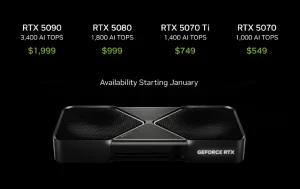
The RTX 5090 Graphics Card is NVIDIA’s current flagship consumer GPU and, according to NVIDIA, the most powerful GeForce graphics card ever produced [1]. Built on the new Blackwell architecture and equipped with 32 GB of GDDR7 memory on a 512-bit memory bus, it targets enthusiast gamers, AI developers, 3D artists, and content creators who need top-tier rendering and machine-learning performance [1][10]. With a manufacturer’s suggested retail price of $1,999, it sits at the highest tier of the consumer GPU market and competes directly with workstation-class hardware in many production workloads [7].
This guide breaks down what the RTX 5090 actually delivers, how its new features work, what third-party models are available in the United States, and what buyers should consider before spending nearly two thousand dollars on a graphics card.
What the RTX 5090 Is and Who It’s For
The GeForce RTX 5090 is the top-tier card in NVIDIA’s 50-series lineup, positioned above the RTX 5080 and 5070 Ti [1]. It is engineered for 4K and emerging 8K gaming, real-time ray tracing, generative AI workloads, and professional creative applications such as Blender, DaVinci Resolve, and large language model inference [1][10].
NVIDIA targets three primary US audiences with this card. First, enthusiast PC gamers who run high-refresh 4K displays and want maximum frame rates with full path tracing enabled. Second, AI researchers and developers who benefit from the 32 GB VRAM buffer for running larger local models. Third, content creators whose workflows are bottlenecked by GPU rendering, video encoding, or AI-assisted editing tools [1][9].
It is not a mainstream consumer product. Tom’s Guide and PC Gamer both note that the price-to-performance ratio is poor for typical 1080p or 1440p gaming, where lower-tier cards deliver comparable experiences for a fraction of the cost [6][7]. Buyers should match the card to a workload that genuinely requires its capabilities.
Blackwell Architecture and Core Hardware Specs
The RTX 5090 is the first consumer flagship built on NVIDIA’s Blackwell architecture. Key hardware highlights include [1][7][10]:
- Memory: 32 GB GDDR7 on a 512-bit interface
- Tensor Cores: Fifth-generation, with native FP4 precision support
- Ray Tracing Cores: Fourth-generation, with Mega Geometry acceleration
- Streaming Multiprocessors: Redesigned for neural shaders
- MSRP: $1,999
The jump from GDDR6X on the prior generation to GDDR7 substantially increases memory bandwidth, which is critical for 4K texture streaming, AI model loading, and professional rendering [1]. The 512-bit memory bus is wider than the 384-bit bus on the previous flagship, allowing the GPU to feed its compute units more efficiently at high resolutions [3][5].
The new fifth-generation Tensor Cores add FP4 (4-bit floating point) support, which roughly doubles AI throughput compared to FP8 for compatible workloads. This is the technical foundation that makes DLSS 4.5 and Multi Frame Generation possible [1].
DLSS 4.5, Multi Frame Generation, and Reflex 2
The RTX 5090’s most marketed software features are powered by AI rather than raw rasterization. DLSS 4.5 introduces two major upgrades over previous versions [1][8]:
Dynamic Multi Frame Generation is a Blackwell-exclusive technology that can generate up to three additional AI-rendered frames for every traditionally rendered frame. In supported titles, this can multiply effective frame rates by up to four times, enabling smooth gameplay at 4K with full ray tracing enabled [1][8].
Second-generation transformer model replaces the prior convolutional neural network used in DLSS upscaling. The transformer model improves image stability, reduces ghosting, and better preserves fine details in motion [1].
Complementing these is NVIDIA Reflex 2 with Frame Warp, a latency-reduction technology designed to offset the input lag traditionally associated with frame generation. Reflex 2 adjusts rendered frames based on the latest mouse input just before display, reducing perceived latency in competitive titles [1]. It’s worth noting that frame generation works best when base frame rates are already reasonable; it does not substitute for raw GPU performance in CPU-bound or low-fps scenarios.
Third-Party Models Available in the US
NVIDIA’s Founders Edition is sold directly, but most US buyers will purchase a board-partner version. Leading models available through Best Buy, Amazon, Walmart, and specialty retailers include [2][3][5][9]:
| Model | Key Features | Cooling |
|---|---|---|
| GIGABYTE Gaming OC (GV-N5090GAMING OC-32GD) | 32GB GDDR7, factory overclock, DisplayPort + HDMI | WINDFORCE triple-fan |
| MSI Ventus 3X OC | 32GB GDDR7, 2452 MHz boost, 3x DisplayPort 2.1a, HDMI 2.1b | Triple-fan Ventus |
| MSI Lightning Z | Extreme overclocking headroom, premium VRM | Custom high-end cooler |
| PNY RTX 5090 OC | 32GB GDDR7, factory tuned | Triple-fan design |
All board-partner cards share the same core GPU silicon and 32 GB GDDR7 on a 512-bit interface. Differences come down to cooling efficiency, factory clock speeds, build quality, warranty length, and physical size [3][5][9]. Several of these cards exceed three slots in width and may not fit smaller ATX cases, so buyers should verify clearance before purchasing.
Pricing, Availability, and Scalping Concerns
The RTX 5090 carries an MSRP of $1,999, but actual street prices have frequently exceeded that figure due to high demand and constrained supply [7]. PC Gamer and other outlets have documented persistent scalping, with secondary-market listings sometimes appearing well above the official price [7].
For US buyers, the most reliable purchasing channels are authorized retailers including Best Buy, Amazon, Walmart, Newegg, and Micro Center, as well as direct sales from NVIDIA when Founders Edition stock is released [2][3][8]. Pre-built systems are another route around individual GPU shortages. The HP OMEN MAX Desktop, for example, ships with an RTX 5090 paired with an AMD Ryzen 9 9900X3D processor, 128 GB of RAM, and 8 TB of SSD storage, providing a turnkey high-end configuration [2].
Buyers should be cautious of third-party marketplace listings without verified seller credentials. Counterfeit and modified GPUs have appeared in past launch cycles, and the Federal Trade Commission generally recommends purchasing high-value electronics only from authorized resellers to preserve warranty coverage and consumer protections.
Real-World Performance and Power Requirements
In published reviews, the RTX 5090 delivers the highest frame rates currently available in 4K gaming, particularly in path-traced titles where DLSS 4.5 Multi Frame Generation is supported [1][7]. In productivity workloads such as Blender Cycles, OctaneRender, and Stable Diffusion inference, the additional VRAM and Tensor Core throughput translate into substantial real-world time savings over prior-generation cards [1].
However, this performance comes with significant power draw. The card’s total board power is among the highest ever shipped in a consumer GPU, and NVIDIA recommends a high-wattage power supply with the appropriate 12V-2×6 connector. Buyers upgrading from older systems will often need to budget for a new PSU in the 1,000-watt range or higher, plus a case with sufficient airflow [7].
Tom’s Guide’s reviewer specifically cautioned that, for most gamers, the diminishing returns above the RTX 5080 do not justify the price difference, and that the 5090 makes the most sense for users with specific 4K, VR, AI, or professional rendering needs [6].
What Experts Recommend
Reviewers and industry analysts converge on several recommendations for prospective RTX 5090 buyers. First, match the GPU to the monitor. The card’s value scales sharply with resolution and refresh rate; pairing it with a 1080p or even 1440p display wastes most of its capability [6][7].</p
Second, confirm the rest of the system can support it. A modern high-core-count CPU such as a Ryzen 9 9000-series or Intel Core Ultra 9 part is recommended to avoid CPU bottlenecks at lower resolutions, along with at least 32 GB of system RAM and PCIe 5.0 storage for the best load times [2].
Third, do not pay scalper prices. Industry coverage consistently advises waiting for restocks at MSRP rather than overpaying on secondary markets, since supply typically stabilizes within several months of a flagship launch [7].
Finally, content creators and AI developers should evaluate whether their software actually benefits from the additional VRAM and FP4 acceleration. For pure 1440p gaming, lower-tier 50-series cards offer dramatically better value [6].
Frequently Asked Questions
References
- GeForce RTX 5090 Graphics Cards | NVIDIA
- RTX 5090 — Best Buy
- GIGABYTE GeForce RTX 5090 Gaming OC 32G — Amazon
- MSI GeForce RTX 5090 Graphics Cards — MSI US Store
- MSI Gaming RTX 5090 32G Ventus 3X OC — Amazon
- I review gaming PCs for a living, and I’d never buy the RTX 5090 — Tom’s Guide
- Nvidia GeForce RTX 5090 specs — PC Gamer
- NVIDIA GeForce RTX 5090 — Walmart
- PNY RTX 5090 32GB Triple Fan GPU — Empowered PC
Frequently Asked Questions
- How much does the RTX 5090 cost in the US?
- NVIDIA’s official manufacturer’s suggested retail price for the RTX 5090 is $1,999. However, actual street prices have often run higher due to limited supply and active scalping in the secondary market. Board-partner cards from GIGABYTE, MSI, and PNY may carry premiums over MSRP depending on cooling and overclocking features. The most reliable way to pay close to MSRP is to monitor authorized retailers such as Best Buy, Amazon, Newegg, Walmart, and Micro Center for restocks. Pre-built desktops can sometimes provide easier access to the GPU when standalone cards are sold out.
- Is the RTX 5090 worth buying for gaming?
- For most gamers, no. The RTX 5090 makes sense primarily if you game at 4K or higher with ray tracing enabled, run a VR headset with high pixel density, or also use your PC for AI workloads or professional rendering. Reviewers including Tom’s Guide note that the 5090’s advantage over the 5080 is meaningful only in demanding scenarios, and that 1080p or 1440p players will see little benefit. If your primary use is competitive esports or mid-tier AAA gaming, a lower-tier 50-series card delivers far better value for the money.
- What power supply do I need for the RTX 5090?
- The RTX 5090 has one of the highest power draws of any consumer graphics card and uses the 12V-2×6 power connector. NVIDIA and most board partners recommend a high-quality power supply rated at 1,000 watts or higher for a complete system. The exact requirement depends on your CPU and other components, but ATX 3.1-compliant units with native 12V-2×6 cables are strongly preferred to avoid using adapters. Cheap or older PSUs are not recommended; under-powered units can cause crashes, throttling, or in rare cases damage to the GPU connector.
- What is DLSS 4.5 Multi Frame Generation?
- DLSS 4.5 Multi Frame Generation is an AI feature exclusive to NVIDIA’s Blackwell-based GPUs, including the RTX 5090. It uses the card’s fifth-generation Tensor Cores to generate up to three additional frames for every traditionally rendered frame, which can multiply effective frame rates by roughly four times in supported games. DLSS 4.5 also uses a new transformer-based upscaling model that improves image clarity and reduces artifacts compared to earlier versions. NVIDIA Reflex 2 with Frame Warp works alongside it to reduce input latency, which is particularly important for fast-paced or competitive titles.
- How much VRAM does the RTX 5090 have, and why does it matter?
- The RTX 5090 ships with 32 GB of GDDR7 memory on a 512-bit interface. This is a substantial increase over the prior flagship and matters most for workloads that exceed the memory budget of smaller cards. Examples include 4K and 8K gaming with high-resolution texture packs, professional 3D rendering scenes, large video editing timelines, and running local AI models such as large language models or Stable Diffusion at higher resolutions. For most 1440p gamers, 32 GB is more memory than necessary, but for creators and AI developers it removes a major bottleneck.
- Where can I buy an RTX 5090 in the United States?
- The RTX 5090 is sold through authorized US retailers including Best Buy, Amazon, Walmart, Newegg, and Micro Center, as well as direct from NVIDIA when Founders Edition stock is available. Board-partner cards from GIGABYTE, MSI, and PNY are widely listed at these retailers. Pre-built systems containing the RTX 5090, such as the HP OMEN MAX Desktop, are another option when standalone cards are scarce. Avoid unverified third-party marketplace sellers, as counterfeit or modified GPUs occasionally appear during launch cycles and may not carry valid manufacturer warranties.
- Can the RTX 5090 be used for AI and machine learning work?
- Yes. The RTX 5090 is well-suited to local AI and machine learning workloads thanks to its 32 GB of GDDR7 memory and fifth-generation Tensor Cores with native FP4 precision support. The large VRAM buffer allows users to run bigger language models, diffusion models, and training jobs locally without offloading to system memory. FP4 support roughly doubles inference throughput for compatible models compared to FP8. While professional data centers still rely on NVIDIA’s H100 and B100 accelerators, the RTX 5090 is currently one of the most capable consumer cards available for individual AI developers and researchers.
- Will the RTX 5090 fit in my PC case?
- Possibly, but check carefully. Most RTX 5090 board-partner cards, including the GIGABYTE Gaming OC and MSI Ventus 3X OC, are large triple-fan designs that occupy three or more expansion slots and may exceed 13 inches in length. Before buying, measure the available clearance in your case for both length and width, and verify that your motherboard’s PCIe slot will support the card’s weight or that the card includes a support bracket. Smaller ATX or micro-ATX cases may not accommodate the 5090, in which case a case upgrade or pre-built system may be necessary.